A short note on Chemiosmosis

9:29 PM

 A short note on Chemiosmosis


CHEMIOSMOSIS:

In both cyclic and non-cyclic phosphorylation, the mechanism for ATP synthesis is chemiosmosis, the process that uses membranes to couple redox reactions to ATP production.


(1) Pumps Protons (H+):

Electron transport chain pumps protons (H+) across the membrane of thylakoids in case of photosynthesis into the thylakoids space.

They energy used for this pumping comes from the electrons moving through the electron transport chain.


(2) Potential Energy:

This energy is transformed into potential energy stored in the form of H+ gradient across the membrane.


(3) ATP Synthase:

Next the hydrogen ions move down their gradient through special complexes called ATP synthase which are built in the thylakoid membrane.

During this diffusion of electrons, the energy of electrons is used to make ATP


A short note on Chemiosmosis  A short note on Chemiosmosis Reviewed by SaQLaiN HaShMi on 9:29 PM Rating: 5

The Mechanism of Opening and Closing of Stomata

5:53 AM

OPENING AND CLOSING OF STOMATA:


The guard cells function as multisensory hydraulic valves.

Environmental Factors:

Environmental factors such as:

(i) Light intensity and quality.

(ii) Temperature.

(iii) Relative humidity and

(iv) Intracellular CO2 concentration are sensed by guard cells and these signals are integrated (combine) into well-defined stomatal responses.


These are two hypothesis which may explain the opening and closing of stomata.

(1) Starch Sugar Hypothesis:

The German Botanist H. Van Mohl proposed that the guard cells are the only photosynthesising cells of epidermis of leaf.

Sugar are produced in the guard cells during day time when light is available.

(i) During Day Time:

When sugar level rises i.e. solute concentration increases or water potential decreases and the guard cells become turgid, and they separate from one another and stoma or pore opens.

(ii) During Night:

During night there is no photosynthesis the sugars are either converted into in soluble starch or are used in respiration, this decreases free sugars in cell.

So the osmotic pressure of guard cells is lowered, and water leaves the guard cells. They become flaccid and stoma or pore between them closes.

But these process are not fast enough to account for the rapid rise in turgor, of guard cells.

(2) Influx of Kᐩ Ions:

Potassium concentration in guard cells increases several folds,

Depending upon plant species.

(i) Stomata Open:

Stomata open due to active transport of potassium ions (Kᐩ) into the guard cells from the surrounding epidermis.

The accumulation of Kᐩ decreases the osmotic potential of guard cells.

Water enters the guard cells by osmosis, which become more turgid and stretched and stomata are opened.

(ii) Stoma Closes:

The stoma closes by reverse process; involving passive diffusion of K⁤ᐩ from guard cells followed by water moving out by osmosis.


What Controls the Movement of Kᐩ into and out of Guard Cells ?

  • Level of carbon dioxide in the spaces inside the leaf end.
  • Light, control this environment.

(i) Level of Carbon Dioxide:

A low level of carbon dioxide favors opening of the stomata, thus allowing an increased carbon dioxide level and increased rate of photosynthesis.

(ii) Light Quality and Intensity:

Exposure to blue light, which is also effective in photosynthesis has been shown to acidify the environment of the guard cells (i.e. pumps out protons) which enable the guard cells to take up Kᐩ followed by water uptakes resulting in increased turgidity of guard cells.

So in general stoma are open during day and closed at night.

This prevents needless loss of water by the plant when it is too dark for photosynthesis.

(iii) Actively Pumping Potassium:

The plant open their stomata by actively pumping potassium in guard cells causing water to follow by osmosis.

Guard cells become turgid and stoma or pore opens.

When Potassium leaves the guard cells (during night) water leaves the guard cells by exosmosis and guard cells become flaccid and stoma or pore between guard cells closes.

The Mechanism of Opening and Closing of Stomata The Mechanism of Opening and Closing of Stomata Reviewed by SaQLaiN HaShMi on 5:53 AM Rating: 5

The Mechanism of Phloem Translocation or pressure flow

8:17 AM


THE MECHANISM OF PHLOEM TRANSLOCATION:


Pressure-Flow Theory:

The theory called, Pressure-Flow Theory, is the most acceptable theory for the transport in the phloem of angiosperms.

Evidence to Support this Theory:

We have considerable evidence to support this theory.

Two Categories:

There were two main categories of theories to account for movement of sap in phloem.

(i)   Active Theories:

The Active theories involving the use of energy for the movement of materials in phloem.

(ii)   Passive Theories:

The passive theories in which no use of energy was involved. The active theories have all been abandoned (alone, with out support) as there is not much evidence to support these theories.

Now we are left with Passive theories of transport/translation.

These Include:

(i) Diffusion

(ii) Pressure flow theory

(i)  Diffusion:

Diffusion is far too slow, to account for the velocities of sugar movement in phloem, which on the average is 1 meter per hour, while the rate of diffusion is 1 meter per eight years.

So we are left with pressure flow theory.

Pressure Flow Theory:

A hypothesis was first proposed by Ernst Munch in 1930.

It states that the flow of solution in the sieve elements is driven by an osmotically generated pressure gradient between source and sink.

Now this hypothesis has been given status of a theory.

See figure, the following steps, explain pressure flow theory.

(i) The glucose formed in the photosynthesizing cells, is used within the cell (for respiration etc) and the rest is converted in to non-reducing sugar i.e., sucrose.

(ii) This source is actively transported through the bundle sheath cells to the companion cell of the smallest vein in leaf a short distance transport (involving 2-3 cells).

Thus sucrose diffuses through plasmodesmata to sieve tube cell or sieve element, raising the concentration of sucrose in it.

The pathway taken by sucrose is symplast in most cases; but in some, apoplastic movement does take place.

The sucrose is actively transported to the sieve elements.

(iii) The water moves by osmosis from the nearby xylem in the leaf vein.

This increase the hydrostatic pressure of the sieve tube element.

(iv) Hydrostatic pressure moves the sucrose and other substances in the sieve tube cells, and moves to sinks e.g. fruits.

In the storage sinks, such as sugar beet root and sugarcane stem, sucrose is removed into apoplast prior to entering symplast of the sink.

(v) Water moves out of the sieve tube cell by osmosis, lowering the hydrostatic pressure.

In symplastic, pathway sucrose (or sugars) moves through plasmodesmata to the receiver cell.

Thus according to pressure flow theory, the pressure gradient is established as a consequence of entry of sugars in the sieve elements at the source; and removal of sugars (sucrose) at the sink

The energy driven energy of sugars in sieve tube elements, generate high osmotic pressure in the sieve tube elements of the source causing a steep drop in the water potential.

(vi) The pressure of sieve plants greatly increase the resistance along the pathway and results in the generation and maintenance of a substantial (considerable) pressure gradient in the sieve elements between source and sink.

The sieve element's contents are physically pushed along the transportation pathway by bulk flow, much like water flowing through a garden hose.

The pressure flow theory accounts for the mass flow of molecules within phloem.

It may be noted that the photosynthate or carbohydrates from the mesophyll cells to phloem tissue involves diffusion and active transport (carrier mediated transport).

Then in phloem tissue (sieve tubes) the movement of materials is according to pressure flow theory.

Again in the sink cells when the sugar and the carbohydrates are passed from the phloem tissue, diffusion and carrier mediated transport, either passive or active, takes place.

The Mechanism of Phloem Translocation or pressure flow The Mechanism of Phloem Translocation or pressure flow Reviewed by SaQLaiN HaShMi on 8:17 AM Rating: 5

Aiou past papers MSc Botany 4th Semester

12:54 AM
Aiou past papers MSc Botany 4th Semester Aiou past papers MSc Botany 4th Semester Reviewed by SaQLaiN HaShMi on 12:54 AM Rating: 5

Aiou past papers MSc Botany 2nd Semster

11:54 PM
Aiou past papers MSc Botany 2nd Semster Aiou past papers MSc Botany 2nd Semster Reviewed by SaQLaiN HaShMi on 11:54 PM Rating: 5

Differentiate between Prokaryotic and Eukaryotic cells

9:39 AM
SECTION - III


Attempt any THREE questions:                                                                        (8 x 3 = 24)


Q.6 
       (a) Differentiate between Prokaryotic and Eukaryotic cells.

Ans.        PROKARYOTIC AND EUKARYOTIC CELLS:

Biologists have divided cells into two types: prokaryotic and eukaryotic.
The differences between these two types of cells are mainly based upon the structure of their nuclei.

                         Eukaryote
                         Prokaryote
(i) Eukaryotes have a very well defined nucleus, in which nuclear material (chromosomes or DNA) is enclosed in a double nuclear membrane.

(ii) Those possessing eukaryotic cells are called eukaryotes.

(iii) Eukaryotes includes all other unicellular or multicellular organisms such as animals, plants, fungi and protista. (Containing all membrane bounded organelles)


(iv) Ribosomes compared of eukaryotes 80S.


(v) The cell wall of plants is generally made up of cellulose.


(vi) Eukaryotic cells are given in diagram.


(i) In prokaryotic cells, however the genetic material (DNA) is without any nuclear membrane covering and is directly submerged in the cytoplasm.

(ii) Organisms possessing prokaryotic cells are called prokaryotes.

(iii) Prokaryotes include bacterial and blue green algae. Prokaryotic cells generally lack many of the membrane bounded structures found in eukaryotic cells, For Example, mitochondria, endoplasmic reticulum, chloroplast and Golgi apparatus are absent in prokaryotic cells.
Since there is no nuclear membrane, a prokaryotic cell has no distinct nucleus and its DNA molecule is directly suspend in cytoplasm.

(iv) Prokaryotes have small sized ribosomes 70S.
In prokaryotes mitosis is missing and the cell divides by binary fission. Because of their simpler structure, it was widely accepted for a long time that prokaryotic cells represent a more primitive stage of evolution than eukaryotic cells Perhaps the most distinctive features of the prokaryotic cell is its cell wall, composed of polysaccharide chains bound covalently to shorter chains of amino acids forming.
Peptidoglycan and Murein.

(v) The entire cell wall is often regarded as a single huge molecule or molecular complex called Sacculus or murein and is differently structured than that of a bacterium.

(vi) Diagrams of prokaryotic.


Q.6 
        (b) Explain the nutrition in fungi.

Ans.     NUTRITION IN FUNGI:
  • All fungi lack chlorophyll and are heterotrophs (obtaining carbon and energy from organic matter).
  • They obtain their food by direct absorption from the intermediate environment and are thus absorptive heterotrophs.
(1) Saprotrophs:
  • Most fungi are saprotrophs (or saprobes), decomposers that obtain their food (energy, carbon and nitrogen) directly from dead organic matter.
  • They secrete out digestive enzyme which digest dead organic matter, and all organic molecules thus produced are absorbed back into the fungus.
  • Saprobic Fungi anchor to the substrate by modified hyphae, the rhizoids.
  • Fungi are the principal decomposers of cellulose and lignin, the main components of plant cell walls (most bacterial cannot break them).
  • Extensive system of fast growing hyphae provides enormous surface for absorptive mode of nutrition.
  • Saprobic fungi, along with bacteria, are the major decomposers of the biosphere, contributing to the recycling of the elements (C, N, P, O, H etc) used by living things.
(2) Parasites:

Some fungi are parasites.

Haustoria:
  • Parasitic fungi absorb nutrient directly from the living host cytoplasm with the help of special hyphal tips called hustoria.
  • They may be obligate or facultative.
(i) Obligate Parasites:
  • Obligate parasites can grow only on their living hosts and cannot be grown on available defined growth cultures medium.
  • Various mildews and most rust species are obligate parasites.
(ii) Facultative Parasites:
  • Facultative parasites can grow parasitically on their host as well as by themselves on artificial growth media.
(3) Predators:
Some fungi are active predators.

(i) Oyster Mushroom (Pleurotus Ostreatus) is a carnivorous (predatory) fungus:
  • It paralyses the nematodes (that feed on this fungus), penetrate them, and absorb their nutritional-contents, primarily to fulfil its nitrogen requirements.
  • It fulfills its glucose requirements by breaking the wood.
(ii) Arthrobotrys:

Some species of arthrobotrys trap soil nematodes by forming contricting ring, their hyphae invading and digesting the unlucky victim. Other predators have other adaptations, such as secretion of sticky substances.
Mushroom Oyster ~200g/pkt – Gocer E-MartLee Davies🦑🍄 🏳️‍🌈 on Twitter: "Its #WormWednesday, so here's ...

(4) Mutualistic Symbiotic:
  • Fungi form two key mutualistic symbiotic association (associations of benefit to both partners).
  • They are lichens and mycorrhizae.
(i) Lichens:
  • Lichens are mutualistic and have symbiotic associations between certain fungi mostly Ascomycetes and imperfect fungi, and few Basidiomycetes (about 20 out 15000 species of lichens) and certain photoautotrophes either green algae or a cyanobacterium, or some times both.
  • Most of the visible part of lichens consist of fungus and algal components are present within the hyphae.
  • Fungus protects the algal partner from strong light and desiccation and itself gets food through they courtesy of alga.
  • Lichens can grow at such place where neither of the components along can even at harsh places such as bare rocks etc.
  • Lichens vary in colour, shape, overall appearance, growth form.
Bioindicators: They are ecologically very important as bioindicators of air pollution.

LICHEN BIOLOGY – Ohio Plants

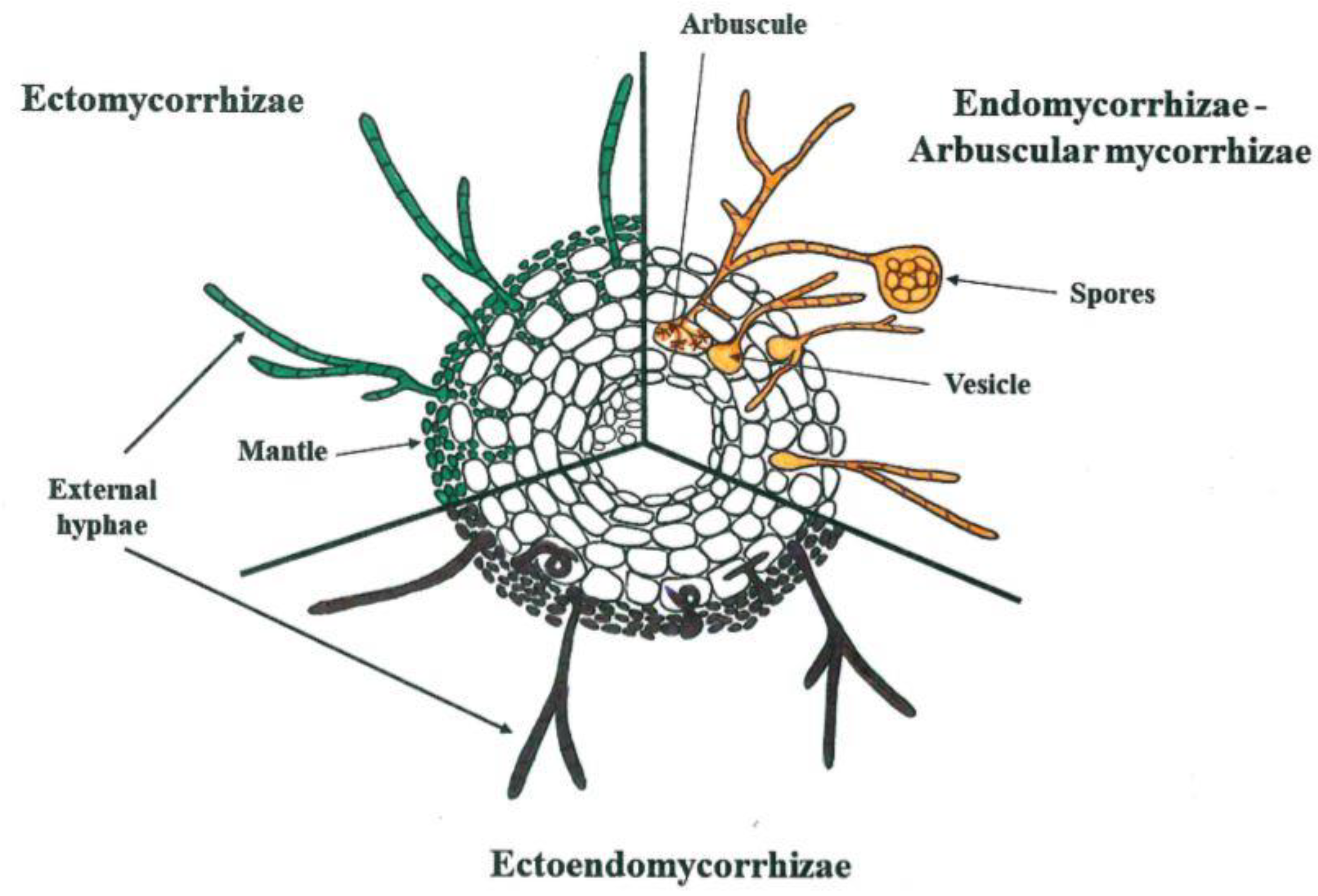
(ii) Mycorrhizae:
  • Mycorrhizae are mutualistic association between certain fungi and roots of vascular plants (about 97% of all kinds of vascular plants).
  • The fungal hyphae dramatically increase amount of soil contact and total surface area for absorption and help in the direct absorption of phosphorus, zinc, copper and other nutrients from the soil into the roots. Such plants show better growth than those without this association.
  • The plant, on the other hand, supplies organic carbon to fungal hypahe.

Types:

There are two main types of mycorrhizae

(a) Endomycorrhizae:

Endomycorrhizae, in which the fungal hyphae penetrate the outer cells of the plant root, forming coils, swellings and minute branches, and also extend out into surrounding soil;

(b) Ectomycorrhizae:

Ectomycorrhizae in which the hyphae surround and extend between the cells but do not penetrate the cell walls of the roots. These are mostly formed with pines, firs etc.

However, the mycelium extend far out into the soil in both kinds of mycorrhizae.

Agronomy | Free Full-Text | A Review of Studies from the Last ...

Habitat:

Fungi grow best in moist habitats, but are found wherever organic matter is present.

Temperature and pH:
  • They survive in dry conditions in some resting stage or by producing resistant spores.
  • They can also tolerate a wide range of pH from 2 - 9, a wide temperature range, and high osmotic pressure such as in concentrated salt/sugar solutions as in jelly, jam etc.
  • These features also help them in their survival on land.

Reserve food Material:

Fungi store surplus food usually as lipid droplets or glycogen in the mycelium.
Differentiate between Prokaryotic and Eukaryotic cells Differentiate between Prokaryotic and Eukaryotic cells Reviewed by SaQLaiN HaShMi on 9:39 AM Rating: 5
Theme images by lucato. Powered by Blogger.