The Body of Fungus

5:42 AM
Explain the body of fungus?
THE BODY OF FUNGUS:

Mycelium:

The body of a fungus is called mycelium. (except yeasts which is non-hyphal unicellular fungi).

Hyphae:

Mycelium is composed of long slender, branched, tubular, thread like flaments called the hyphae (single hypha). Hyphae spread extensively over the surface of substratum. Their walls are composed of chitin, so their wall is more resistant to decay than are cellulose and lignin which is present in plant cell wall. Hyphae may be septate or non-septate.

Septate Hyphae:

Septate hyphae are divided by cross walls called septa (singular septum) into individual cells containing one or more nuclei. Septa of many septate fungi have pores through which ribosomes, mitochondria and even nuclei flow from cell to cell. Thus materials are carried to growing tips and enabling the hyphae to grow rapidly when food and water are abundant and temperature is favourable. Septate hyphae may be monokaryotic having one nucleus per cell or dikaryotic having two nuclei per cell.


Non-Septate Hyphae :

Non-septate hyphae lack septa and are not divided into individual cells. These are in the form of an elongated multinucleated large cells. Such hyphae are called coenocytic hyphae which consists of a continuous cytoplasmic mass with hundreds or thousands of nuclei. The coenocytic condition results from the repeated division of nuclei without cytoplasmic division.

Functions of Hyphae:

(i) Extensive spreading system of hyphae provides large surface area for absorption of nutrition, Parastitic fungi usually have some of their hyphae modified as haustoria, nutrient-absorbing hyphal tips that penetrate the tissue of the host.


(ii) Hyphae may be packed together and organized to form complex reproductive structures such as mushrooms, puff ball, morels etc., which can be expand rapidly. All fungal nuclei are haploid except for transient diploid zygote that forms during sexual reproduction.


A single mycelium may produce up to a kilometer of new hyphae in only one day. A circular clone of Armillaria, growing out from a central focus, has been measured up to 15 hectare (1 hectare = 10000m²) Armillaria is a pathogenic fungus afflicting conifers.
The Body of Fungus The Body of Fungus Reviewed by SaQLaiN HaShMi on 5:42 AM Rating: 5

Organisms In Kingdom Fungi & Its Taxonomy

6:32 AM
What type of organisms are included in kingdom Fungi? Also describe their taxonomic status.


FUNGI - THE KINGDOM OF RECYCLERS:

Approximately 100,000 species of organisms called "fungi" are known and thousands are thought to be present. This group includes

(i) Pathogens such as rusts, smuts of wheat and corn and molds found growing on important crops and foodstuff.

(ii) Delicate species such as mushrooms, truffles and morels.

(iii) Organisms of commercial use such as Penicillium. It is also source of antibiotic penicillin.

(iv) Yeast it is used in bakeries and breweries.

Ecological role of fungi as decomposers is paralleled only by bacterial.

Taxonomic Status of Fungi:

Taxonomic status of fungi has changed from that of a group of plant kingdom. Now they are placed in a separate kingdom "Fungi".

Plant - Like Characters:

They resemble plants in some respects:

(i) They have cell wall.

(ii) They lack centrioles.

(iii) They are non-motile.

Animal - Like Characters:

Fungi resemble, more animals than plants. They show following animal-like characters:

(i) Fungi are heterotrophs.

(ii) They lack cellulose in their cell wall and contain chitin-a nitrogen containing polysaccharide also found in exoskeleton of arthropods. For this reason, some mycologists (scientists who study fungi) think that fungi and animals probably arose from a commom ancestor.

Differences between Fungi and Animals:

Fungi are different from animals in following ways:

(i) Fungi have cell wall.

(ii) They are absorptive heterotrophs.

(iii) They are non-motile.

So fungi are neither plants nor animals.

Fungi Different from all Organisms:

(i) DNA Studies:

Their DNA studies also confirms that they are different from all other organisms.

(ii) Nuclear Mitosis:

They show a characteristic type of mitosis, called 'nuclear mitosis'. During nuclear mitosis, nuclear envelope does not break; instead the mitotic spindle forms within the nucleus and the nuclear membrane constricts between the two clusters of daughter chromsomes. (In some fungi nuclear envelop dismantles late).

Conclusion:

As fungi are distinct from plants, animals and protists in many ways, they are assigned to a separate kingdom 'Fungi'.

Organisms In Kingdom Fungi & Its Taxonomy Organisms In Kingdom Fungi & Its Taxonomy Reviewed by SaQLaiN HaShMi on 6:32 AM Rating: 5

Two to Five Kingdom Classification

7:02 AM

Explain the Two to Five kingdom classification.

MODIFICATION OF OLD CLASSIFICATION:

Two to Five Kingdom Classification Systems:

Different classification systems recognize Two to five kingdoms

For centuries, the living organisms have been classified into Two kingdoms, plants and animals.

(1) Kingdom (Plante):

Plant can prepare their own food from simple inorganic material and store energy (autotroph), while.

(2) Kingdom (Animalia):

Animals cannot synthesize their own food from simple inorganic material and depend for their food either on autotrophs or on decaying organic matter (heterotrophs).

Objection in Old Classification:

Bacteria were included in plants.

Many biologist found this system satisfactory, while other found it unworkable for many unicellular organisms like.

Euglena that have both plant like (presence of chlorophyll) and animal like (lack of cell wall) characters and also because it.

Ignores the differences between Prokaryotic and Eukaryotic cells.

(3) Kingdom (Protista):

In 1866, Ernst Hackel proposed a third kingdom PROTISTA to accommodate Euglena like organisms and bacterial.

In 1937, E-Chatton suggested differentiating terms:

Procariotique (from Greek pro, meaning before, and karyon, meaning nucleus) used to describe bacterial and blue-green algae, and Eu-caritique (from Greek eu, mean true) to describe animal and plant cells.

(4) Kingdom (Fungi):

Some biologists also disagree about the classification of FUNGI, such as bread mold, yeast and mushrooms, which, Resemble plants in many ways but are not autotrophs.

Fungi are special forms of heterotrophs that obtain energy and structural material by breaking down (decomposing) and absorbing food substances from the surroundings, and possess chitin as a major structural component in their cell walls.

(5) Kingdom (Monera):

Robert Whittaker (1969):

A relatively recent system of classification, the five kingdom system, was proposed by Robert Whittaker (1969).

This system of classification is based on three different levels of cellular organization associated with three principal modes of nutrition.

(i) Photosynthesis.

(ii) Absorption and

(iii) Ingestion.

The Five Kingdoms Proposed:

(i) (MONERA) the prokaryotic unicellular organisms such as bacterial,

(ii) (PROTISTA) the Eukaryotic predominantly unicellular organisms such as Euglena and Amoeba

(iii) (PLANTAE) the Eukaryotic multicellular Autotrophs

(iv) (FUNGI) the Eukaryotic multicellular Reducers: (mushrooms)

(v) (ANIMALIA) the Eukaryotic multicellular Consumers

PLANTS are autotrophic in nutritional mode, making their own food by photosynthesis such as mosses, ferns, flowering plants.

FUNGI are heterotrophic organisms that are absorptive in their nutritional mode.

Most fungi are decomposers that live on organic material.

Secrete digestive enzymes and absorb small organic molecules which are produced by digestion.

ANIMALS live mostly by ingesting food and digesting it within specialized cavities.

They lack cellulose and show movements for example birds, reptile.

In five kingdom classification all eukaryotes that did not fit the definition of plants, fungi, or animalia were included in Protista.

Most Protists are Unicellular forms, but this kingdom also includes relatively simple multicellular organisms that are believed to be direct descendants of unicellular protists.

Modification of 5 Kingdom System:

Lynn Margulis and Karlene Schwartz (1988) modified five kingdom classification of Whittaker by considering

(a) Cellular organization

(b) Mode of nutrition

(c) Cytology, Genetics &

(d) Organelles of Symbiotic origin (Beneficial relationship Mitochondria, Chloroplast)

These five kingdom are in modified forms:

(i) Prokaryotae (Monera),

(ii) Protoctistsa (Protists),

(iii) Plantae,

(iv) Animalia and

(v) Fungi
Two to Five Kingdom Classification Two to Five Kingdom Classification Reviewed by SaQLaiN HaShMi on 7:02 AM Rating: 5

Structure and Life Cycle of Bacteriophage

9:36 AM

Write structure and life cycle of Bacteriophage?

STRUCTURE OF T4:

The structure under an electron microscope looks like a tadpole and consists of a head and tail.

(1) Head:

(i) The head is elongated having:

      (a) Pyramidal (having two triangular structures with a common base).

      (b) Hexagonal or

      (c) Prism-shaped structure.

(ii) To it straight tail is attached.

(iii) Head contains double-stranded DNA.


(2) Tail:

The structure of the tail is more complex than the head.

(i) Tail has a core of protein which is surrounded by a sheath of another protein.

(ii) On one side of the sheath is the collar and on the other side is the end plate (Base plate).

(iii) Six tail fibers are attached to the end plate. These fibers are for attachment.


Volume of Phage:

It is about 1/1000 of the host.


Life Cycle of Bacteriophages:

The bacteriophage replicates only inside the bacterial cell. There are many steps in replication.


(1) Attachment (Adsorption) of Phage to the Host Cell:

(i) First of all the bacteriophage attaches to the bacterial cell at the receptor site. The receptor sites are present on the cell wall of the bacterium.

(ii) During attachment, weak chemical union occurs between virion and receptor site.


(2) Penetration:

In this step, the tail releases the enzyme lysozyme. This enzyme dissolves a portion of the bacterial cell wall.

The tail sheath contracts and the tail core is forced into the cell through the cell wall and cell membrane.

The virus injects its DNA into the cell (just as the syringe is used to inject the vaccine).

The protein coat, consisting of head and tail, remains outside the cell.

Many animal viruses enter the host cell as a whole.

A Phage Injecting its DNA in to host

After penetration one of the following cycles take place:

(1) Lytic cycle.

(2) Lysogenic cycle.


(1) Lytic Cycle:

During the lytic cycle following steps occur.

(i) Multiplication:

Soon after entering the bacterium, the viral DNA takes the control of the biosynthetic machinery of the host.

The host is forced to synthesize viral DNA and proteins. As a result, viruses begin to multiply.

Within 25 minutes about 200 new Bacteriophages are formed.


(ii) Lysis

After the formation of bacteriophages, the bacterial cell bursts (lysis occurs).

Newly formed bacteriophages are released to infect other bacteria. A new lytic cycle may start.

The phage that causes the lysis of the host cell is called lytic or virulent phage.


(2) Lysogenic Cycle:

In some cases instead of the lytic cycle, the lysogenic cycle takes place. It occurs as follows:

(i) Formation of Prophage:

The viral DNA does not take over the control of the host's machinery.

The DNA is incorporated into the bacterial chromosome. Phage at this stage is called prophage and this process is known as lysogeny.

The phage which causes lysogeny is called temperate (lysogenic) phage. 

Lysogenic bacteria are resistant to infection by the same or related phages.


(ii) Replication:

During lysogeny, the bacterium lives and reproduces normally.

Viral DNA is the part of a bacterial chromosome and passes to each daughter cell generation after generation.

(iii) Induction:

Some times the viral DNA detaches from the chromosomes of the host and the lytic cycle starts. This process is called induction is spontaneous or environmentally induced excision of the prophage from the bacterial chromosome. 

Structure and Life Cycle of Bacteriophage Structure and Life Cycle of Bacteriophage Reviewed by SaQLaiN HaShMi on 9:36 AM Rating: 5

First Law of Thermodynamics (ΔE = qv)

6:03 AM

State first law of thermodynamics and prove ΔE = qv.

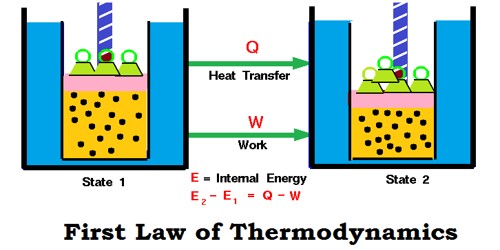
First Law of Thermodynamics

"This law is also called the law of conservation of energy. This law is stated as, "energy of the universe is constant".

(OR)

"Energy can neither be created nor destroyed but can change from one form to another."

In other words, a system cannot destroy or create energy. However, it can exchange energy with its surrounding in the form of heat or work. Thus the energy change is the sum of both heat and work so that the total energy of the system and its surroundings remains constant.

Consider a gas enclosed in a cylinder having a piston. Suppose the internal energy of the system is E1. A quantity of heat q is given to the system and work W is done on the piston to keep it in its original position. During these operations, the internal energy of the system changes to E2, the change in internal ΔE is given by the following equation, which is the mathematical form of the first law of thermodynamics.

                    E2 - E1  =  ΔE = q + W

                    ΔE  = q + W

Sign of q will be positive when heat is supplied to the system and q is negative when heat flows out side across the boundary. W is negative when work is done by the system and W is positive when work is done in the system. Pressure volume work is given mathematically as:

                    Work = Force  x  Distance

An external pressure P exerted by a force F, spreads over the area A, as pressure is force per unit area.

                    P  =  F/A    or     F  =  P x A

The volume of the gas in the cylinder is equal to cross-section area A multiplied by the height of the column of the gas h.

                    V  =  A  x  h 

Now, let us assume that the gas expands and does work by pushing the piston against external pressure, "A" remains the same but "h" changes.

               ΔV  =  V2  -  V1

                    ΔV  =  Ahf  -  Ahi

                    ΔV  =  A (hf - hi)

                    ΔV  =  A  Δh

Work done by expansion of gas against constant pressure is given by

                    W  =  -F  x  Δh

                    W  =  -P  x  A  x  Δh

                    W  =  -P ΔV

The negative sign indicates that work is done by the system on the surrounding. So first law of thermodynamics can be written as:

                    ΔE  =  q  -  P ΔV

Energy changes at constant volume

If the volume of gas does not change, no work is done, (ΔV  =  0). By applying the first law of thermodynamics.

                    ΔE  =  qv  -  P ΔV

                    ΔE  =  qv  -  0      (ΔV = 0)

                    ΔE  =  qv

So the increase of heat at constant volume (qv) increases only the internal energy (ΔE) of the system and work done is zero.

First Law of Thermodynamics (ΔE = qv) First Law of Thermodynamics (ΔE = qv) Reviewed by SaQLaiN HaShMi on 6:03 AM Rating: 5

Hybridization, with Example of sp² hybridization

7:52 AM

What is hybridization? Explain sp² hybridization with example.

"The process of mixing orbitals of different energy and shape to form set of new orbital of the same energy and same shape is called Hybridization and orbitals obtained are called hybrid orbitals".


sp²-Hybridization

The process of mixing one 's' and two 'p' orbitals to form three equivalent sp² hybrid orbitals is called sp2-Hybridization.

Each sp² orbital consists of 's' and 'p' in the ratio of 1 : 2 respectively.

sp²-hybrid orbitals lie at the angle of 120° in a plane. The geometry of the molecules is trigonal planar.


Formation of Ethylene or Ethane (C2H4) Molecule

Electron configuration of C (6) = 1s ⇵, 2s ⇵, 2px↑, 2py↑, 2pz

Excited state = 1s ⇵, 2s ↑, 2px ↑, 2py ↑, 2pz ↑

One s and two p orbitals intermix to form three hybrid (sp²) orbitals. The geometry of molecules depends upon the number of hybrid orbitals. Hybrid orbitals are trigonal planar and are oriented at the angle of 120°. Each atom is left with one half filled p-orbital perpendicular to the planar sp² hybrid orbitals. Each carbon atom undergeos sp² -s, overlaps with two hydrogen atoms and sp² -sp² overlap between themselves to form sigma bonds. These overlaps lead to the following shapes. The partially filled p-orvbitals undergo overlap sideways to form a pi-bond. So, a pi-bond is formed by the sideways overlap of two half filled co-planar p-orbital in such a way that the probability of finding the electron is maximum perpendicular to the line joining the two should be made clear that a π-bond is formed between two atoms only, when the with a sigma bond.

Hybridization, with Example of sp² hybridization Hybridization, with Example of sp² hybridization Reviewed by SaQLaiN HaShMi on 7:52 AM Rating: 5
Theme images by lucato. Powered by Blogger.